
Home / IRIS Power Saver
Power line quality improved filter
IRIS: use less energy for the same work
A compact, passive device connected in parallel to your low-voltage distribution board. It reduces the active power (kWh) drawn by motors, compressors and pumps, and we prove the saving on your own meter.
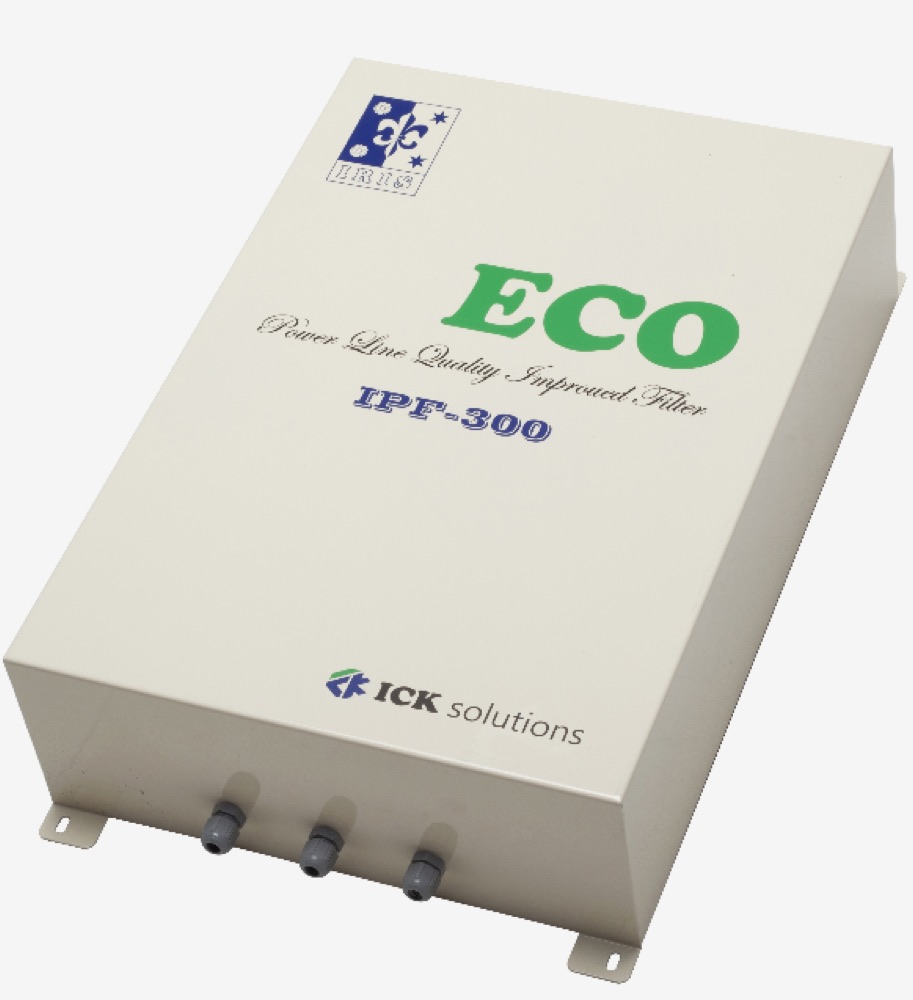
What it is
A passive filter, not another gadget
IRIS is made by ICK Solutions of Seoul, South Korea, from a patented composite of dielectric ceramic and carbon nanotubes. Motors, compressors and pumps create electrical noise and losses every time they start, stop and cycle. According to the manufacturer, IRIS reduces those losses so the same work draws less energy.
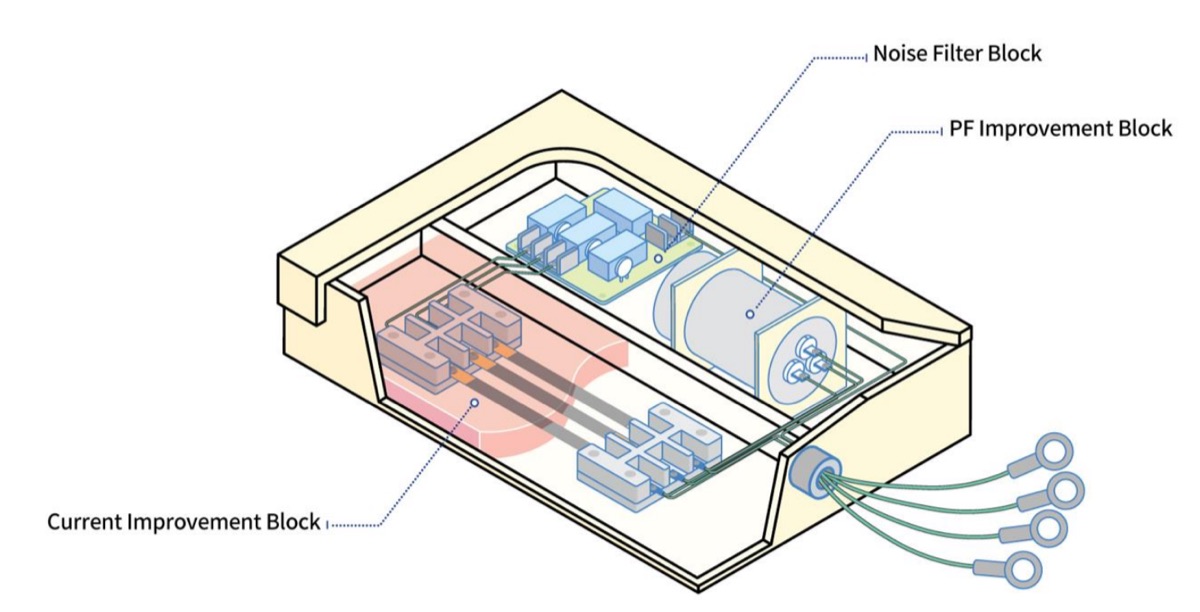
- Connected in parallel: load current does not pass through it, so your equipment keeps running even if IRIS is disconnected
- No electronic circuit, no software, no moving parts
- Does not reduce or regulate your supply voltage
- Installed in about 30 minutes per unit during a short planned isolation
We do not ask you to accept the theory. We log your incoming supply, install IRIS, log again and you compare the numbers yourself.
Field results
Measured savings on real sites
Results reported by the manufacturer and its partners from metered before-and-after studies. Savings depend on the load mix: most sites land between 8% and 13%.
Past results do not guarantee the saving at your site. Full case study reports are available on request.
Is IRIS right for you?
Where it works, and where it does not
IRIS performs best on direct-on-line inductive loads that run long hours and cycle on and off. We check this before we quote.
A strong fit
- Fixed-speed chillers, chilled-water pumps, cooling towers and AHU fans
- Refrigeration: cold rooms, freezers, display cases, compressor racks
- Air compressors with load/unload or start/stop cycling
- Water transfer, booster, irrigation and process pumps
- Presses, cutting, moulding, conveyors, cranes and hoists
- Sites on low voltage (up to 440 V for NF, 600 V for IPF) running 16 to 24 hours a day
Not suitable
- Loads driven by VFDs, inverters or soft starters, including inverter chillers and VRF systems
- Medium-voltage motors and boards (3.3 kV and above)
- Boards that are mostly resistive: heaters, ovens, kilns and lighting
- Sites that cannot allow a metered before-and-after comparison
On mixed boards we install only on the direct-on-line feeders. If your site is a poor fit, we will say so.
Expected saving by load mix
Manufacturer's guide table. Used to set expectations, then confirmed with a pilot.
| Inductive (motor) share of load | Typical sector | Expected saving |
|---|---|---|
| 90% | Heavy industry, manufacturing plants | 13.5 – 16.3% |
| 70% | Light industry | 10 – 12.9% |
| 50% | Supermarkets, cold chain, high cooling use | 7 – 9.5% |
| 30% | Buildings, hotels, restaurants | 4 – 6.1% |
| 10% | Lighting-heavy sites | 2 – 2.7% |
Savings estimator
What could IRIS save you?
An illustration based on the manufacturer's guide ranges. A site survey and metered pilot give the real figure.
Assumes the saving applies to the energy (kWh) part of the bill for boards fitted with IRIS. Fixed and demand charges are not affected.
Estimated annual saving
- Guide saving range
- –
- Annual electricity spend
- –
- At the 5% guaranteed minimum
- –
Product range
Two series, seventeen models
The NF series is the upgraded version with added noise filtering and power-factor improvement. The IPF series covers a wider voltage range and suits sites where power factor is already close to 1.0.
Upgraded: up to 18%
- Power-loss compensation
- Power-factor and harmonic-noise improvement
- Power-noise filtering and ESD protection
- 100–440 V, 50/60 Hz, 10 to 1,000 kVA
Original: up to 15%
- Power-loss compensation
- Wider input range: 100–600 V, 50/60 Hz
- Draws about 1 mA line current
- 10 to 500 kVA; larger sites use distributed units
| Load capacity | Phase | NF model | NF size (cm) / weight | IPF model | IPF size (cm) / weight | Activation |
|---|---|---|---|---|---|---|
| 10 kVA | 1Φ | NF-10 | 11×16×5 / 2 kg | IPF-10 | 9×12×6 / 1.3 kg | 0.5 day |
| 20 kVA | 1Φ | NF-20 | 12×18×6 / 3 kg | IPF-20 | 12×16×6 / 2.3 kg | 1 day |
| 30 kVA | 3Φ | NF-30 | 17×25×7 / 4 kg | IPF-30 | 14×20×7 / 3 kg | 2 days |
| 50 kVA | 3Φ | NF-50 | 18×27×8 / 5 kg | IPF-50 | 17×24×7 / 6 kg | 3 days |
| 100 kVA | 3Φ | NF-100 | 22×31×10 / 7 kg | IPF-100 | 20×28×10 / 9 kg | 5 days |
| 200 kVA | 3Φ | NF-200 | 26×38×10 / 9 kg | IPF-200 | 26×38×10 / 15 kg | 7 days |
| 300 kVA | 3Φ | NF-300 | 29×40×11 / 11 kg | IPF-300 | 30×43×12 / 20 kg | 10 days |
| 500 kVA | 3Φ | NF-500 | 35×50×12 / 15 kg | IPF-500 | 30×47×15 / 30 kg | 14 days |
| 1,000 kVA | 3Φ | NF-1000 | 37×54×14 / 23 kg | – | Units in parallel | 21 days |
Sizing rule: IRIS rating (kVA) ≥ breaker or transformer capacity × 1.2, then the next model up. Example: a 400 V, 100 A board is about 69 kVA; with margin, 83 kVA, so an NF-100 or IPF-100. Specifications may change as the manufacturer improves the product.
How a project runs
Prove first, then roll out
Survey and sizing
We check voltage, load type and breaker or transformer capacity, and choose between NF and IPF.
Baseline logging
A power logger records the incoming side of the board, typically for two weeks.
Install and activate
A licensed electrician connects IRIS on the load side of the breaker. Activation takes 0.5 to 21 days by model.
Measure and report
We log again under comparable conditions and report kWh, cost and CO₂ saved.
Installation
Thirty minutes, four steps
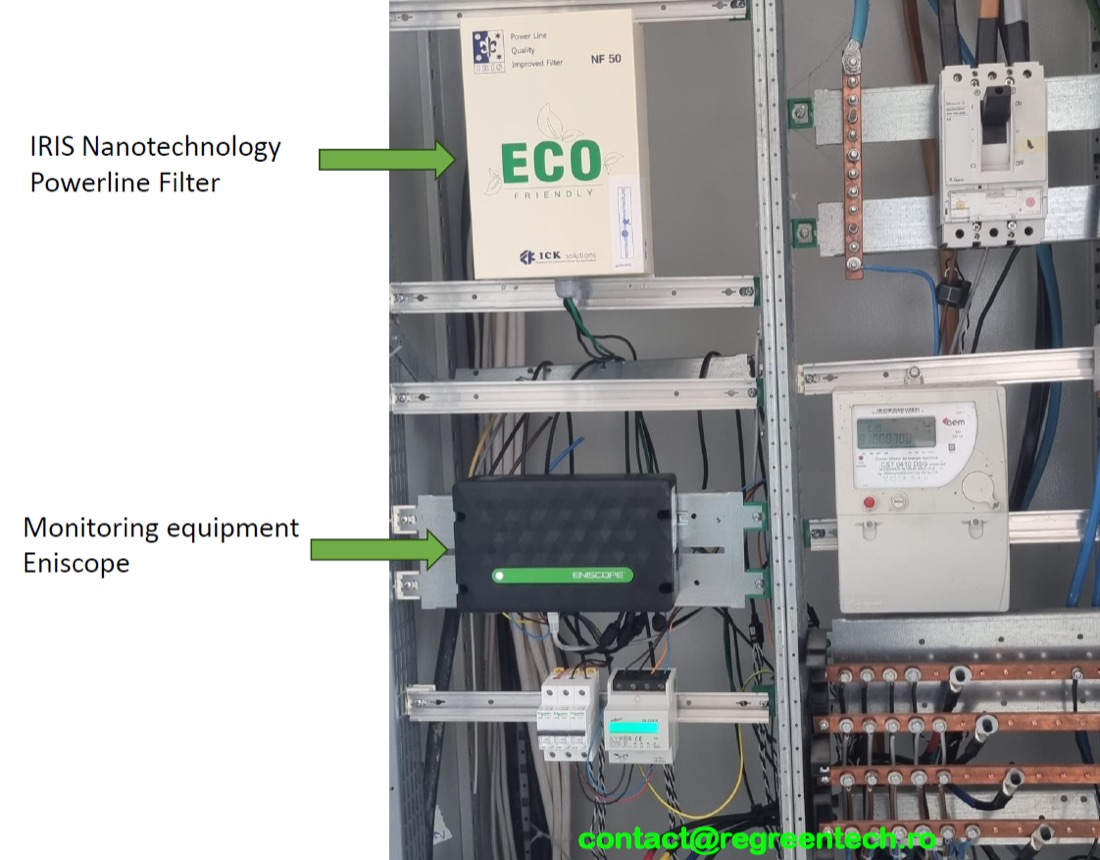
- Mount the unit on the wall beside the panel, or inside it where space allows
- Isolate the breakers and prove the board dead
- Connect the IRIS leads to the load-side terminals of the main or sub-circuit breaker
- Restore power and confirm all loads are running normally
For the best performance on larger sites, units are distributed on the sub-boards close to the motor loads. Installation is always carried out by a qualified electrician under a permit to work, in line with local authority wiring regulations.
Certificates and warranty
Documented and patented
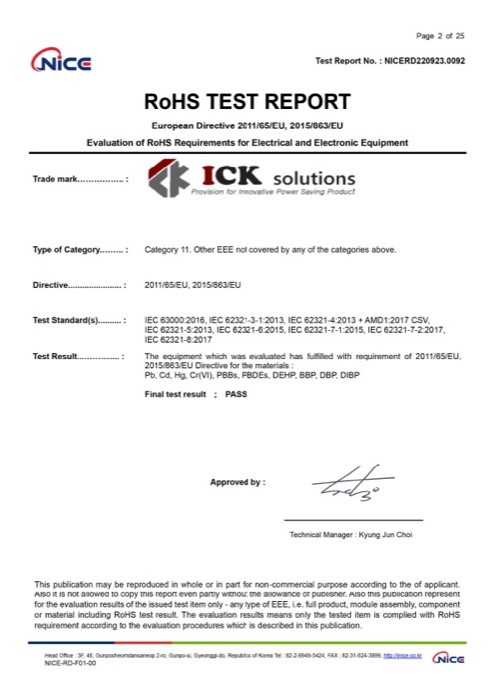
Certificates cover electrical safety and materials compliance. Copies and model-specific details are available on request.



5-year full warranty
Free replacement of defective units within five years, handled locally by Omega Energy.
Minimum 5% guarantee
The manufacturer's performance guarantee on the saving rate, verified by measurement.
Zero maintenance
No electronic parts and no moving parts. Once activated, IRIS needs nothing further.
Common questions
Straight answers
We have tried energy savers before and they did not work. Why is this different?
You are right to be sceptical. That is why we do not ask you to buy on our word. We log your incoming supply, install IRIS, log again, and you compare the numbers on your own data.
We already have capacitor banks. Is IRIS still useful?
IRIS can be installed alongside capacitor banks. A capacitor bank corrects power factor; IRIS targets load loss. Where power factor is already well corrected the saving may be lower, which is exactly why we pilot first. In these cases we usually recommend the IPF series.
Our motors run on VFDs. Can we use IRIS?
Not on those circuits. The manufacturer does not recommend IRIS with inverters or soft starters. We look instead at your direct-on-line loads such as compressors, pumps, fans and cold rooms.
Will it reduce our voltage or affect sensitive equipment?
No. IRIS is passive and connected in parallel. It does not regulate or drop the supply voltage, and your equipment sees the same voltage as before.
How long before we see results?
IRIS needs an activation period of between half a day and 21 days, depending on the model. Results are measured after activation, under conditions comparable to the baseline.
What does IRIS cost?
Pricing depends on the models and number of units your site needs. After a short survey we provide a proposal with the expected saving range and payback.
By sector
IRIS for your kind of site
Factories
Air compressors, presses, conveyors and process pumps: where the loads are, what has been measured and how a pilot runs around production.
Cold stores
Fixed-speed compressor racks, fans and pumps that run day and night, and how the saving is measured fairly across seasons.
Start with one board
Pick a motor-heavy board and let the meter decide. We will survey, size and run a before-and-after test.